Another look at new thoughts on Tapton’s history, courtesy of the Derbyshire Victoria County History (VCH). This time we briefly look at the Court House, across the railway line on Brimington Road, Tapton.
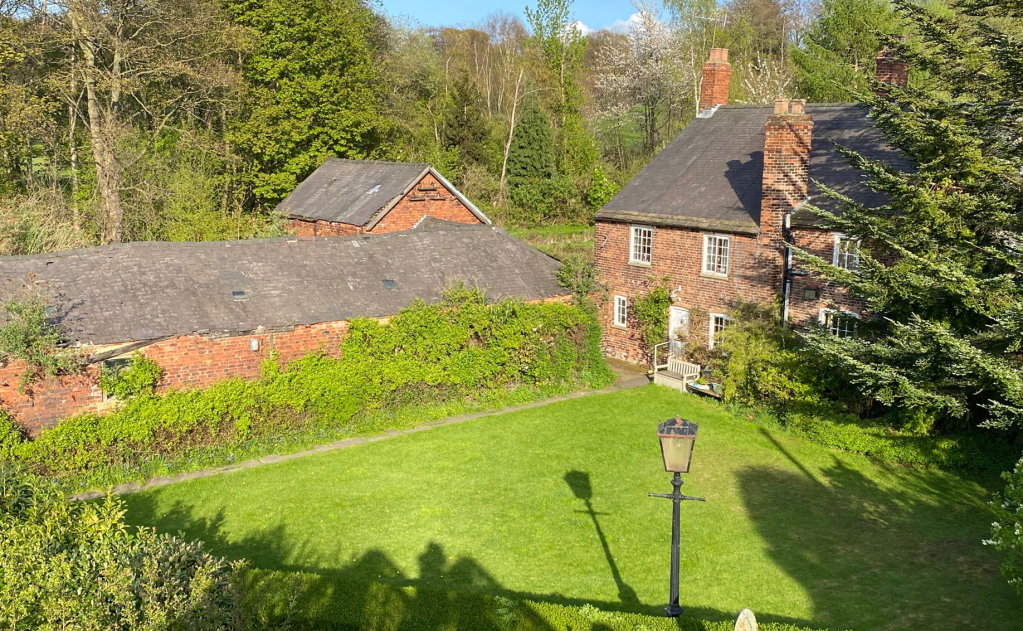
Cote House – now The Court House – is a corruption. There was no courthouse here.
But Cote House was already in existence in 1559 when it was on lease from Rowland Durant to Richard Johnson alias Edmondson.
The present brick-built house and outbuildings probably date from the late 18th century. In 1796 an estate auction sale included four houses and three cottages at Cote. This may be the property, said to be at ‘Coate’, purchased in 1799 by Isaac Wilkinson from the Revd D’Ewes Coke of Brookhill Hall (in Pinxton) and his wife. If so, several houses have since been demolished at Cote.

In the 19th century Cote was the name of a single dwelling, occupied at different dates as both a farm house and by farm labourers. In 1907 Cote House farm was owned by Mrs Markham and let with 30 acres to a George Marshall.
Cote House passed to Chesterfield Corporation as part of the Tapton House estate in 1925 but was later sold.
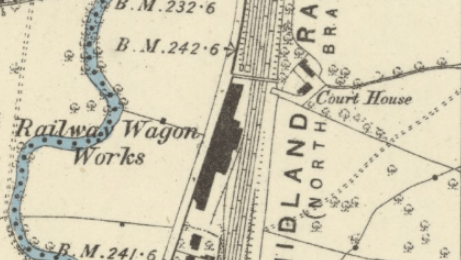
Surveyed: 1876, Published: 1883 – courtesy the National Library of Scotland – https://maps.nls.uk)
And our theory about its current ‘Court House’ name?
We think that it started to appear as this due to a misunderstanding when the Ordnance Survey people visited the area. Could they have asked the occupant what the property’s name was, to receive a broad Derbyshire reply; ‘It’s the Cote House’, which actually sounded to the chap from the OS as Court House?
Whatever the reason there was certainly no documentary evidence that courts of any kind were ever held here!
The blog is one of number following a talk to our local history group in April 2022 on ‘New thoughts on Brimington’s and Tapton’s History’. When VCH publishes its account on Brimington and Tapton, it will address the history of this property more fully.
 Brimington and Tapton Local History Group
The 1881 Census has Edward Eastwood Railway Wagon Builder living at Cote House Tapton Derby with his family. Edward Eastwood established his wagon works in Chesterfield 1863.In 1874 he financed his nephew Edwin Samson Moore and est the Midland Vinegar Co at Aston Cross Birmingham. In 1899 they purchased the rights to HP Sauce, manufactured there until 2007
LikeLike
Thanks for your comments. Was Eastwood living at the Cote House as a prelude to constructing Tapton Villa (his later home within the Wagon Works)? Something that has also intrigued us is where did Edward get his money from? Surely not just from his wagon works activities?
LikeLike
There is a book at Chesterfield library “The Eastwoods of Tapton Villa” the history of Edward Eastwood and all his business ramifications, too long to list in this note, suffice to say his early life saw him leaving for Birmingham with an apprentice as a saddler. His father Joseph was the Hasland Smithy and Edward from a very young age had learnt next to his father that side of the business. Whether Edwards father knew the saddler from Birmingham and set him up as a favour to Joseph one wonders. He left that employment and went to work for S.J.Claye at Long Eaton in 1846. Showing remarkable maturity at only aged 20 he superintended the construction of the Erewash Valley Line from Trent to Ilkelston-completed in 1847. By the age of 35 in 1861 he had become the works manager of S.J.Claye who by that time had become wagon builders for the coal industry.. This was the era of “railway mania” investors were falling over themselves and perhaps unsurprisingly with his experience aged 37 Edward was a sure bet for a successful return for any investors. Within a decade of setting up his Chesterfield wagon works he had become a multi millionaire. He invested heavily in the Nottingham lace industry not only in production but also modern machinery. He also had interest in coal mining, ship building..Most noteworthy was his investment and the largest shareholder in Oliver and Co. In 1885 and the need for expansion Olivers raised £86,000 by 1879 Edward Eastwood was the Managing Director. employing over 250 men. By 1886
the companies fortunes took a u turn, the company may of expanded to quickly and the business went into liquidation, Edward Eastwood was the main investor and creditor. The decline in the price of coal,iron etc may of not helped and after three years with no buyers eventually it was bought by C.P.Markham and the rest as they say is history.. Eastwood wagon works continued until 1963.. Apart from the Eastwood book available from Chesterfield library, a published book..HP Sauce My Ancestors Legacy is also available on line.. To your question about Cote House and the 1881 censor, perhaps this was the time that Edward had his Tapton Manor built next to his works to keep a close eye on his business as this was the period of decline in the coal,iron etc industry and as wagons were the main form of transporting those materials around the country and world at large his business could be effected if not monitored 24/7??
LikeLike