This blog, regrettably our first for sometime, looks at the role George Stephenson’s Lockoford Colliery had in promoting an important safety invention – the steam pressure gauge.
Strange coincidence
It’s strange on how different pieces of information can sometimes come together under the most diverse of coincidences. This particular ‘discovery’ occurred when I attended an event at Pleasley Colliery, commemorating the Creswell Colliery disaster of September 1950. On sale at the event, were some copies of a series of memories and old photographs type books. These had been published by the now defunct AD Newspapers Ltd., of Annesley Woodhouse, in the 2000s. Some years ago, I had purchased a couple of these books as their coverage had extended into the north Derbyshire coalfield area.

Whilst thumbing through one copy (the cover is illustrated here), I was intrigued to find a short article on the inventor of the steam pressure gauge – Sydney Smith, alongside a familiar engraved portrait of George Stephenson.
This article brought together a ‘letter’ from George Stephenson about the steam pressure gauge. A local resident had found this letter and passed it on to the book’s publisher. Needless to say I purchased the book!
Letter identifies Lockoford (Tapton) Colliery as the site of an important experiment
The full text of the letter, dated October 15th 1847, is reproduced below. Clearly Stephenson saw its invention as important – which it was. Before this time there had been little in the way of being able to ascertain pressure in steam boilers. Explosions, when safety valves did not work correctly, or were faulty, were not an entirely uncommon event. Being able to see what the pressure was inside a steam boiler would also enable more efficient operation.
A most important invention has been submitted to me for my approval, patented by a Mr. Smith, of Nottingham and intended to indicate the strength of pressure in steam engine boiler. It is particularly adapted for steam boats but may be used in any place where a steam engine is employed.
I am so pleased with it that I have put one up at one of my own collieries.
It works most beautifully showing the rise and fall of the steam in the most delicate manner.
The indicator is like the face of a clock with a pointer making one revolution in measuring from 1 lb to 100 lbs upon the square inch upon the pressure of steam. It is quite from under the control of the engineer or any other person so that its indications may be relied upon – and the construction is so simple that it is scarcely possible for it to get out of order.
I might give a full explanation of the machine, but I think it best to leave that to the inventor himself.
The numerous and appaling accidents which have occurred from the bursting of steam boat and other boilers have induced me to give you these observations which I think desirable to be laid before the public.
I may state that I have no pecuniary interest in the scheme but being the first person to whom it has been shown – and the first person to make use of it – I feel it a duty I owe to the inventor, as well as the public, to make it as universally known as possible.
The indicator is put up at Tapton Colliery near Chesterfield and may be seen any day by any respectable person.
(Signed) GEORGE STEPHENSON
The ‘Tapton Colliery’ that Stephenson refers to in his letter above is clearly that at Lockoford, which has an interesting history, that I will summarise later. Stephenson was keen to promote the device, which he did so enthusiastically. To confirm matters, Stephenson, who was a founding member and first present of the Institute of Mechanical Engineers, submitted one of his frequent letters to the institution, this on the subject of the gauge. The letter was ‘read’ before them on 27 October 1847, only a few weeks after the date of the 15 October letter. In the letter Stephenson states that Sydney Smith of Nottingham had submitted the gauge to him and it was now available to visitors to see at ‘one of my own collieries …’
Stephenson does not mention which colliery it was fitted at, but combining the two letters, we now know the gauge was fitted at Lockoford Colliery. His 27 October letter to the institute states that the gauge had been installed at one of his collieries, but does not identify which one. The earlier letter does, however, indicate that the gauge was installed at Lockoford and that Stephenson was ‘… the first person to make use of it …’.

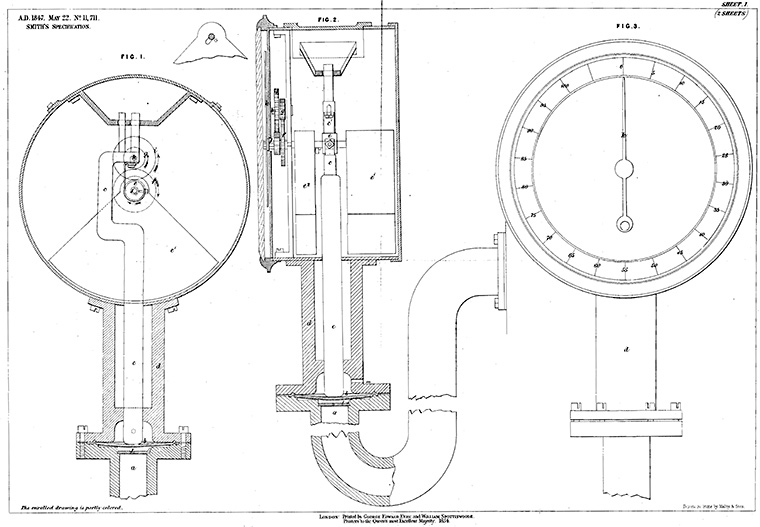
In his letter to the institute Stephenson explains that the steam pressure gauge had been installed ‘… in the engine house a distance from the boilers and [it] works beautifully shewing the rise and fall of the steam in a most delicate manner.’ He then goes into a technical description of the gauge, which is not unlike the steam pressure gauges we know today. At that time Stephenson thought an application of the device might be ‘particularly adapted for steamboats.’
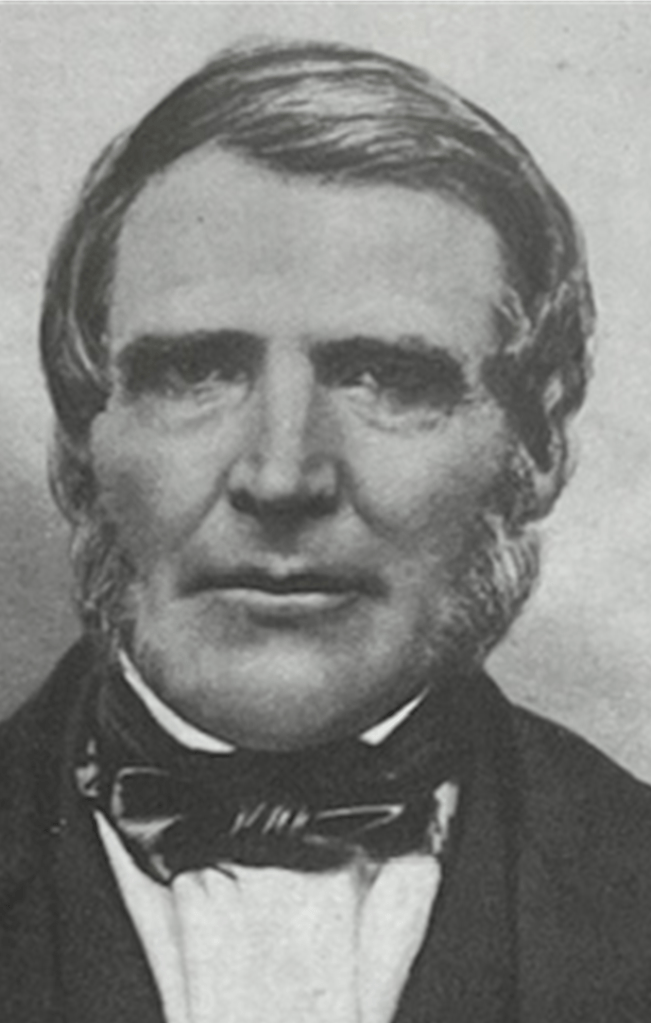
The inventor of the steam pressure gauge
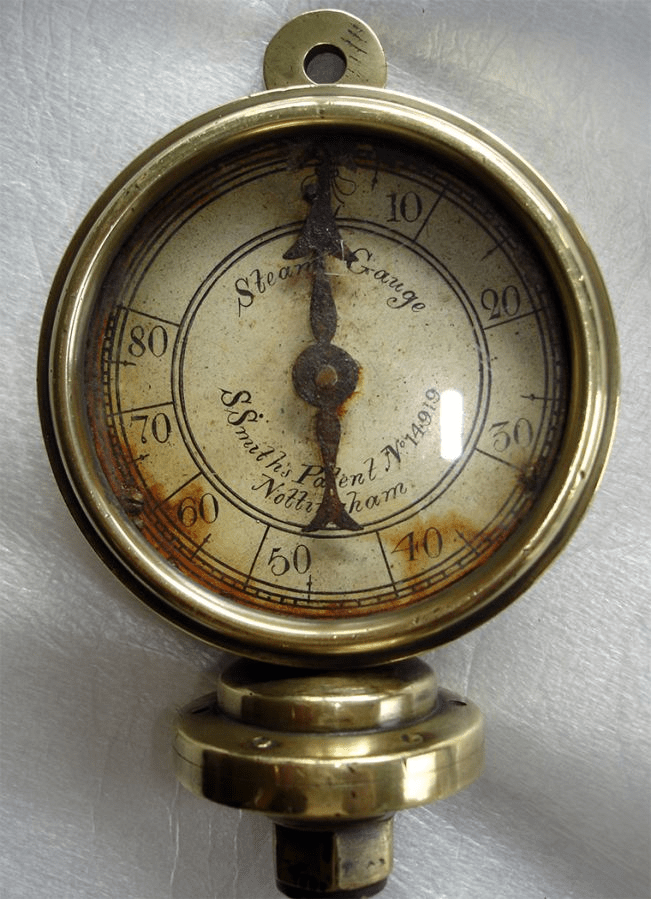
The inventor of this steam pressure gauge was, as described, Sydney Smith (1803-1884) who is said to have invented it when he was 44. Operating from a small foundry at Sneinton, Nottingham, in 1882 the company he then headed made a move to larger premises at Hyson Green, also in the same town (Nottingham was not granted city status until 1897). Although there are other claimants, Smith is now widely credited with its invention. He certainly was the first patentee – 2nd May 1847, Patent No. 11711.
The company still continues as a family-owned concern – the Peter Smith Valve Company. It is now based at Occupation Road, Bulwell, Nottingham, where the manufacture of small to medium size valves is undertaken.
Lockoford Colliery
In this blog I won’t go into a detailed history of Lockoford (or Tapton) Colliery. Suffice to say it had quite a few ups and downs.
Started in 1842 by George Stephenson, by 1898, having gone through a series of closures, reopenings and ownership changes, nearly all traces had disappeared.
In 1843 George Stephenson was paying GY Wilkinson rent for 4 acres for the colliery, which was then probably known as Tapton Colliery. At this time Wilkinson was leasing Tapton House to Stephenson, the latter having lived there since 1838.
At work by 1844 the mine was 600 feet deep. In 1846 it was said to be producing good coal for steelmaking and for making coke for railway locomotives.
In 1848 it was taken over by Robert Stephenson after his father died. In 1855 it was advertised for sale and closed in 1857. 300-400 men and boys were employed there. A dinner was held to mark the event. Apparently, Robert Stephenson had been unable to give the colliery the attention it deserved.
There then followed a series of reopenings and closures, which are not central to this part of the story. The 1876 Ordnance Survey Map extract reproduced here shows the colliery with railway connection, coke ovens along the north side of Lockoford Lane and brickworks to the opposite side of the road. Around this time the company was reported as being wound up. There were two attempts to sell, but the site was reported as still being cleared in 1884.
Making a contribution
At some stage I hope to write another blog post, which will concentrate on Lockoford Colliery itself. I do hope, however that this short account has helped highlight the contribution that the colliery made to the proving of and adoption of the important invention of the steam gauge, world-wide, alongside its inventor and the role Stephenson played in promoting it.
Sources used in this blog
Research carried out by the Derbyshire Victoria County History Chesterfield research group
WO Skeat, George Stephenson. The engineer and his letters, 1973.
M Weiss, The fifth AD Newspapers Ltd. Book of the good old days, 2009.
Grace’s Guide at URL https://www.gracesguide.co.uk/Main_Page.
Published 21 October 2025.
 Brimington and Tapton Local History Group
Very interesting Phillip
LikeLike