We’ve recently had a set of local elections – but in this blog we’re looking back to 1979’s elections in Brimington South Ward and also touching on that in 1987.
Campaigning wise – it was a different world back in 1979. The main opposition to the Labour Party was the Conservatives, who fielded not just one token candidate for two seats, but candidates for both seats. In 1979 the Conservatives were fighting against Labour local government stalwarts Harry Haywood and Henry Bedford for the borough council elections of that year.
In those days campaigning was different and even in hard fought wards, like Brimington South, there would be no cascade of newsletters and other leaflets through your letter box. Generally the major form of communication was the ‘election address’ . We’ve reproduced the Labour address here. The format was pretty standard.
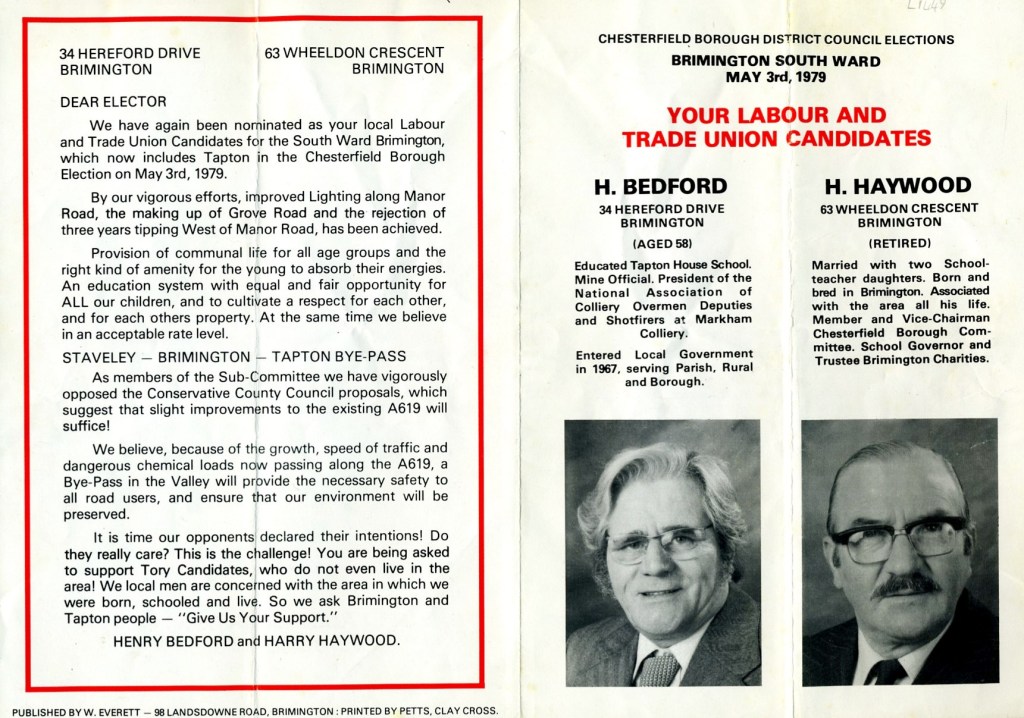
The election address
Most election addresses followed a similar and well-tried formula. Generally the front page (to the right on the above example) would carry candidate photographs and a short biography. The rest would comprise extracts from the the party’s local manifesto coupled with past achievements.
For example, the back page (to the left above) is in the form of a letter from the candidates highlighting their achievements. One example is the relighting of Manor Road. Until the improvements streetlighting there had consisted of a low pressure sodium lighting head being fitted to the old gas light standards. This had resulted in very poor lighting along the whole road – a bone of contention for many years.
Perhaps the number one issue, though, was the Brimington/Staveley by-pass. At this time the Conservative County Council had abandoned its controversial route across Manor Road and Ringwood Lake, from Tapton, in favour of what it termed local schemes. The candidate’s letter is ended with a challenge to their Conservative opponents over the bypass. The saga of this road is also mentioned inside the election address (as shown below).
Geoff Austin (of Highbury Road) and Ian Hoskins (of Inkersall) were standing for the Conservatives. The former had previously represented part of the then new Brimington South Ward – for Tapton had previously been included with his old St Helen’s Ward. The 1979 election saw a new south ward including Tapton and the Brimington Common/Manor Road areas.
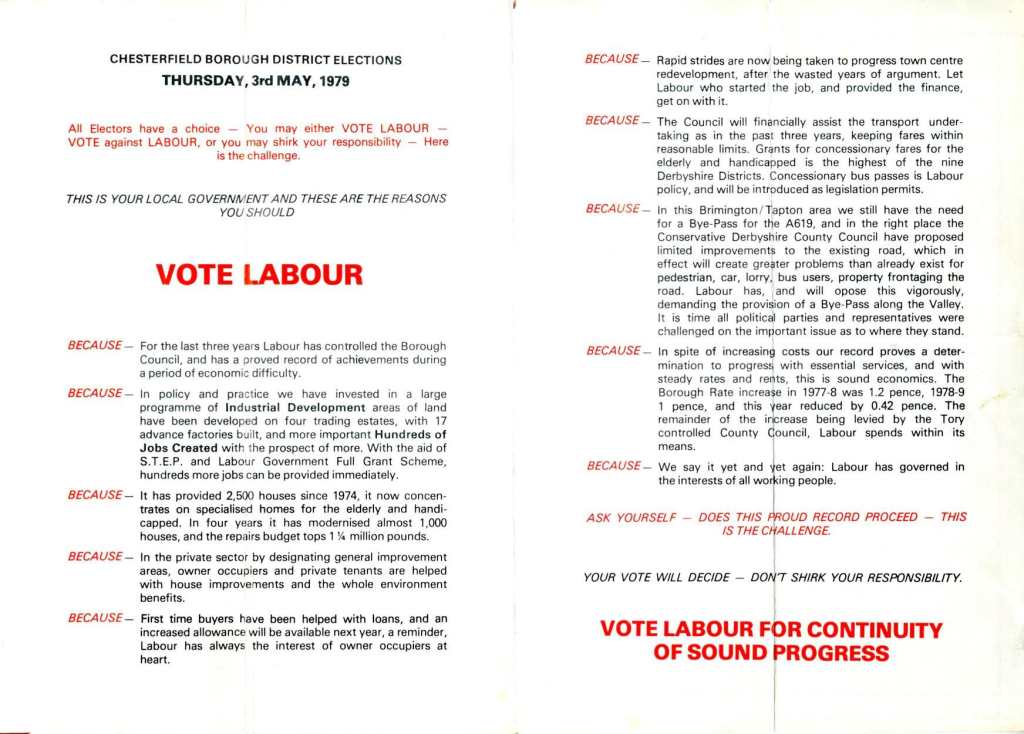
Inside the address are some borough wide issues, but it also focusses on the by-pass issue. At this date the Chesterfield town centre redevelopment is progressing apace. Though the days of council houses being built in large quantities was over, support for both the public and private sector is highlighted.
Traditional campaigning
These were still the days of door-to-door (not telephone) canvassing and election hustings. (Incidentally, it was a tradition for many years that the final parliamentary election husting – on the eve of poll – was held in Brimington. Hustings were public meetings featuring the candidate, who would give a suitably rousing address to the gathered audience. These were usually the faithful many of whom didn’t need to be convinced in any case!)
Labour success in 1979 – but a sad outcome
The Labour candidates were successful in the 1979 election, but Henry Bedford very sadly suffered a fatal heart attack just a few days after he was elected. He was on holiday at his caravan in Skegness, no doubt taking a well-earned rest from the campaign. Henry had first entered local government in 1964 on Brimington parish council. A by-election was held, with the seat being retained for Labour by Shaun Barkley.
Coincidently in May 1979 the parish council elections were uncontested – a feature replicated in this year’s elections.
Onwards to 1987
Harry Heywood was defeated as a South Ward borough councillor (along with his fellow Labour candidate) in the elections of 1987. This saw two SDP/Liberal Alliance candidates elected. One was Paul Holmes, who later went on to become the town’s MP (as a Liberal Democrat). He is still an active borough councillor today – for Whittington – and is leader of the council’s minority Liberal Democrat group.
Harry was elected an Honorary Alderman in October 1987, a title conferred on him by the borough council for services to local government. Along with another stalwart of local government in Brimington – Walter Everett – (so honoured in 1980), until 2004 they were the only holders of that of office. Coincidently, but not surprisingly, Walter Everett is named as Harry’s and Henry’s election agent on the 1979 leaflet.
Harry died in 2001, having continued to serve the community on many local bodies including the parish council, to which he had been first elected in 1951.
Enter a different way of campaigning
The SDP/Liberal Alliance (‘Alliance’) brought a different type of campaigning to elections in Brimington and Tapton (and indeed Chesterfield wide) from 1987 – the Labour Party had some difficulty both understanding and matching this.
Gone were the traditional election address. In Labour’s case these were usually professionally typeset and perhaps agreed some weeks before the election campaign started. The Alliance, following techniques developed by the Liberal Party, favoured topical ‘Focus’ newsletter style publications, which they also distributed outside of elections. These were usually typed, with ‘Letraset’ headlines – cheaply and relatively easily produced, which could quickly react to door-step issues. (Labour had coincidently started a newsletter in Brimington and Tapton – ‘Newsview’ – before the 1987 elections – but did not publish a single edition during the campaign).
A particularly topical issue in Brimington and Tapton during the 1987 election was schools reorganisation – where the Labour controlled county council had plans to close Westwood Schools (at Brimington and Hollingwood) and Tapton House School. This issue was quickly picked by the Alliance candidates.
Labour did not answer or indeed really attempt to set the campaign agenda through leaflets during the campaign. The Conservative campaign was virtually non-existent in 1987 and their vote at least partially collapsed.
Today – a world away from 1979
Today election leaflets are more likely to consist of newsletters, potentially be full colour and most-likely won’t carry the amount of text as the election address of yesteryear. Nor might they carry such a long slogan as that in 1979 – ‘Vote Labour for continuity of sound progress’!
Targeted leaflets, ‘personal’ letters, telephone canvassing and the like are all now part of modern campaigning – particularly where the result may be tight and the parties have the resources. And techniques are still evolving with the onset of social media.
It really is a different world to that of 1979.
 Brimington and Tapton Local History Group