In this blog we continue our look at the claim that victims of the plague were buried near the canal off Cowplingle Lane – a tradition almost certainly incorrect. This is part two of a short series of blogs looking at the plague in Brimington, which visited the village from late 1602 to early 1603, with nine to eleven deaths. (You can visit part one here. Part three is available here).
Where did the notion of plague burials come from?
Just where did this probably incorrect notion of plague burials in Cabbin Close (near the canal off Cowpingle Lane) come from?
The chief protagonists appear to be two local historians who published their accounts of Brimington in the 1920s and 1930s. Since then, as explored below, we’ve probably never recovered the truth from the incorrect deduction they made from Pegge’s 1780s account (see part one of this series for more details about Pegge).
The 1920s and 1930s
In 1937 that usually reliable chronicler of Brimington – Vernon Brelsford – in this ‘History of Brimington’ states that ‘inhabitants of the plague were buried in a field called “Cabbin Close. …”. But he gives no evidence for this statement (though earlier in his brief account he mentions Pegge – presumably the account we discussed in part one). Brelsford’s history was republished in 1989.
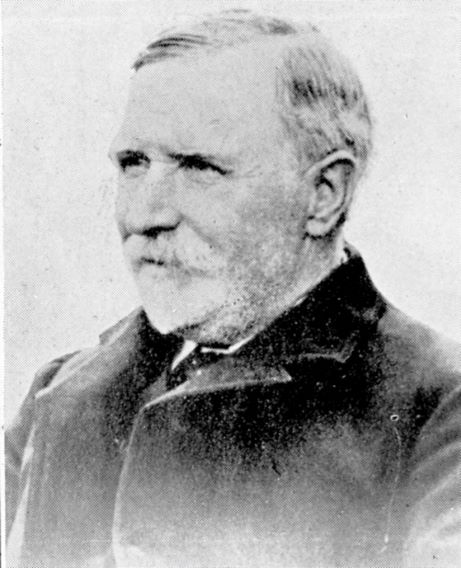
The plague burial notion was probably first raised by another local historian WTG Burr in his early 1920s paper to the North East Derbyshire Field Club. In it he states that inhabitants who died of the plague were ‘interred in a field called “Cabin Close”’.
Burr’s views were given a much wider audience than perhaps even Brelsford’s. Burr also had his paper published in instalments in the Derbyshire Times, which no doubt reached a wide audience. (The edition in which the plague information appeared was 4 March 1922). Additionally, a short-run offprint of Burr’s paper was also produced and circulated locally.
So, there were at least two written accounts of the plague circulating, in less ten years, that almost certainly incorrectly stated that there were plague burials in Cabbin Close. Not one of these accounts gave any source for this information. But the only source is undoubtedly Pegge of the 1780s – who did not explicitly state that there were any such burials.
Again in the 1980s
In the early 1980s the northern part of the parish – around the Bilby Lane area – was threatened with development as an industrial estate of some 27 hectares.
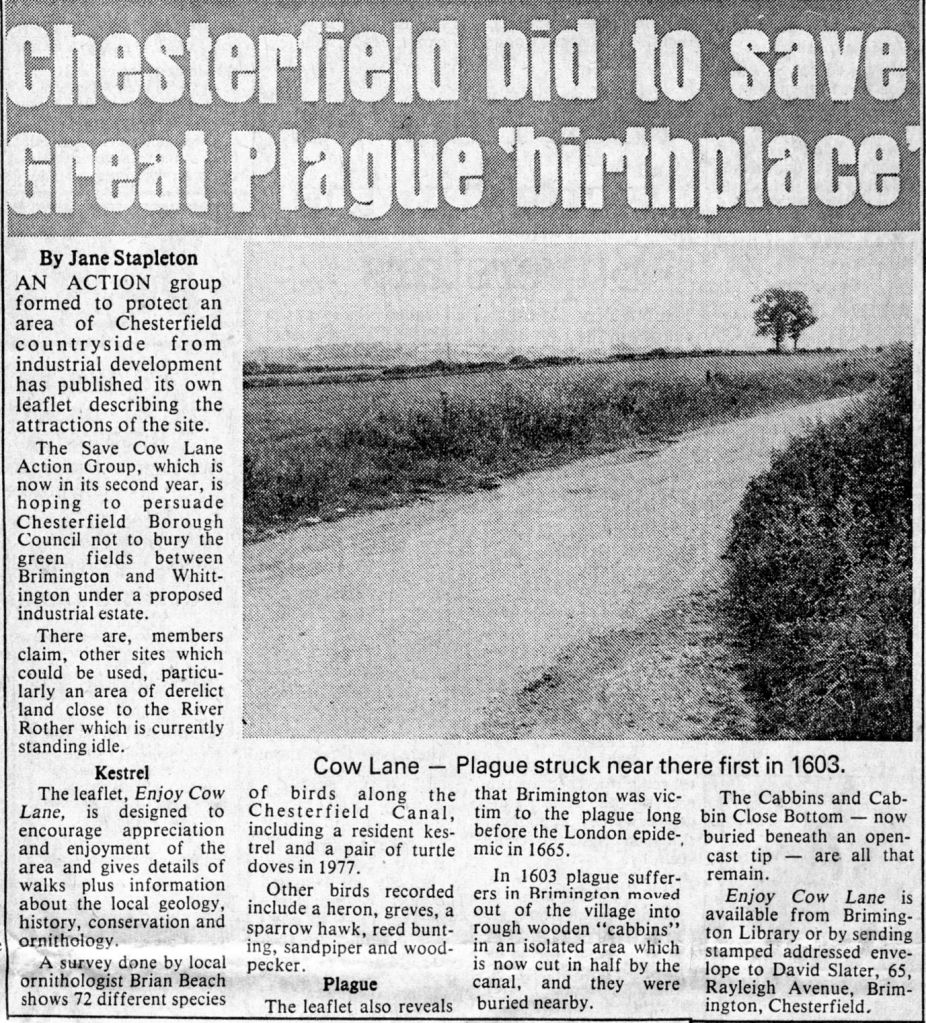
A Save Cow Lane Action Group was established to fight these proposals. In 1983 they published an ‘Enjoy Cow Lane’ leaflet. In this leaflet it was speculated that not only did the plague victims live in cabins in Cabbin Close, but also that they ‘most likely’ died there and were buried in the vicinity.
Local opposition and the associated campaign against the industrial estate attracted the attention of local newspapers. ‘Chesterfield bid to save great plague “birthplace’” was perhaps the most direct newspaper headline. The ‘plague burials’ were a topic when the industrial development issue was covered, particularly at the local plan inquiry held in the autumn of 1983.
All this publicity of ‘plague graves’ would no doubt have increased belief in on-site burials as opposed to the dead being interred in Brimington chapel’s burial ground.
Some six years after the Save Cow Lane Action Group’s leaflet and the industrial estate opposition campaign Brelsford’s history was republished by the parish council. This made available his almost certainly incorrect burial assertion to new readers of the book.
And into the present
Unfortunately, the two main written 20th century accounts, in particular the generally reliable Brelsford, appear to have made it into literature searches for such things as the Derbyshire County Council’s former Sites and Monuments Record (SMR) as ‘Cabbin Close Plague Graves’.
Work to update this and transfer records to the Derbyshire Historic Environment Record, have resulted in ‘Monument record MDR6221 – Plague graves (site of), Cabbin Close, Brimington’. The sources given on the SMR entry appear to be Vernon Brelsford’s history and an unclear reference to the former North Derbyshire Archaeological Trust, who may well have undertaken a desk-top assessment of the area.
The full SMR entry reads:
SK 4032 7455 Cabbin Close, Plague Graves. Graves of the victims of the 1603 plague in the Brimington area. Sufferers were reputedly isolated in the Cabbins and buried in nearby pits. (1, 2) Apparently completely destroyed by open casting and reclamation (May 1989).
Another recent manifestation of this, in what is contended is an incorrect reading of the situation, was raised by Rod Auton in the winter 2022/23 edition of the Chesterfield Canal Trust’s magazine ‘Cuckoo’. Rod wrote about the so-called plague burials, the position of which the crew of the John Varley II canal trust cruise boat were happy to point out to passengers! From correspondence with him, subsequently printed in Cuckoo, Philip Cousins was able to point out that evidence pointed to cabins only being erected on the fields – with no on-site burials. Indeed, this present article is somewhat built on his original reply to Rod.
Summary
- In the 1920s and 1930s two local historians, who had their historical accounts of the parish published, appear to have decided that Pegge indicated plague victims were buried at Cabbin Close. But Pegge does not state this.
- More recently, in the 1980s, the two author’s incorrect assertions are presumably picked-up and gain useful publicity to a campaign against industrial development.
- Presumably the plague burial story has been carried forward since the 1920s, 1930s and 1980s, including currently accessible monument databases, in which it still (as argued here) incorrectly appears.
- There were probably cabins erected for the refuge of plague victims and transmission prevention at Brimington. But it is very doubtful whether there were any burials there.
In our next part in this series we will look further at the two fields – Cabbin Close and Cabbin Close Bottom. We’ll explore what became of them. We’ll also look at why more recent disturbance on the site of at least one of them did not reveal any reportable incidences of graves being found. This is undoubtedly as there weren’t any to be found!
This account is edited from ‘The plaque in Brimington (1603-1604) part 1 – were there plague burials at Cowpingle Lane?’ That account appears in our Brimington and Tapton Miscellany 15, which can be purchased from us and is fully referenced.
 Brimington and Tapton Local History Group
2 thoughts on “The plague in Brimington – 2”