This is the second of our three-part story, describing the Anglican mission church, dedicated to St Mary, which opened in 1878 on Brimington Common. Our first post on this now demolished church can be found here.
The local history group’s yearly publication Brimington and Tapton Miscellany has been looking at the history of this Church of England ‘Tin Tabernacle’ type building in its editions 13 and 14. We’ve used these two articles as our sources here, though this blog, like the first, is shortened. If you want to know more we’d recommend you purchase these two editions.
The mission church was built on land now mainly occupied by 1960s erected council/social housing on Grove Way, near Brimington Manor Infants’ school. The corrugated iron building was approached from an entrance off the present Manor Road. It had a relatively short life, probably closing sometime between the beginning of 1952 and the end of February 1953. This part takes the story up until closure. We will also look at disposal of the building and the land and just what comprised the actual building in part three – our final future blog.
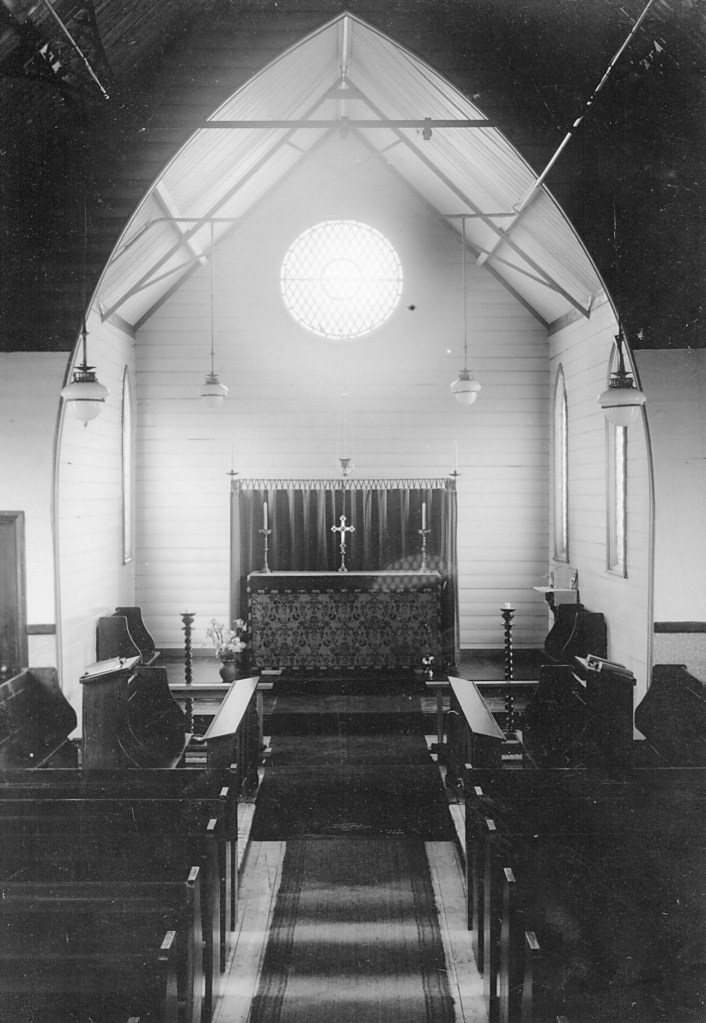
The beginning of the end
We left the story just after the end of the Second World War when the future of St Mary’s looked encouraging. There was talk of a new building (announced by the rector in November 1944), the congregation had increased with an amended service pattern, a Sunday school held, some new services introduced and a choir was being maintained. This success was undoubtedly due to the leadership of The Rev WA Loughborough, Rector of Brimington since 1943, the supporting clergy and congregation, particularly to lay-reader Mr L Drury.
Initially things carried on pretty much as normal, but in 1946 it was reported that commitments from the entire parish to the Diocese would increase. Gifts were made to St Mary’s including a donated a piano from the National School, (which was opposite the parish church on Church Street – we don’t know how well it played!) and new vestments (given by a Mrs Storer in memory of Cpl A Storer, with a memorial plaque dedicated to him, in May).
Around this period the women’s fellowship met every other Wednesday and there was a Wednesday morning Mass. Sundays saw a morning Mass, an afternoon ‘Sunday school and catechism’ with evensong at 6.30 pm. The number of communicants varied from as little as six. In August there had been a total of 43 communicants.
1946, though perhaps showing some promise, might, with the benefit of hindsight, be regarded as the beginning of the end at St Mary’s.
The Rector, in his annual report to the parish in February 1947 stated that St Mary’s had been ‘temporarily closed’ as they had been unable to find a caretaker. As a precaution against recent bad weather, the heating system had been emptied. At this time the Rector had no curate to assist him.
There were other issues too. In March 1947 the PCC thought it would be necessary to raise additional money to pay the church’s way in Brimington. Money had also been spent on the parish church where the heating system had been converted to gas from coke, with decorating and cleaning undertaken. In retrospect this was the beginning of a financial squeeze.
At some stage St Mary’s was reopened, but in the Rector’s report for 1947 (given in early 1948), he reported that St Mary’s had been closed on Sunday evenings due to very poor attendance, though it was noted that both the behaviour and the attendance level of the choir functioning at St Mary’s was high!
There is some uncertainty with the sequence of events at St Mary’s from now on. The last service of evensong seems to have been taken on Holy Innocents Day (28 December) 1947. From the following Sunday only mass was observed, with communicants ranging from four to ten during that month of January 1948. Service registers end on Easter Day, 17 April, 1949, with mass at 9 am – of which there were 12 communicants, the previous service being the Good Friday ‘Stations of the Cross’.
The end?
Did 1949 mark the end? Though the service registers end there are no references in parochial church council (PCC) minutes to the building having been closed, on the contrary there are other references to St Mary’s which might indicate it was still open. However, the PCC had previously reported that ‘it was impossible to consider building a new church on Brimington Common’. Instead, it decided to handover £116. 6d. 7s. raised for the St Mary’s building fund to a plan by the Derby diocese to build new or replacement buildings for seven churches. Locally these included SS Augustine, St Chads, Newbold and at Frechville (now in Sheffield).
Rector the Rev WA Loughborough died in February 1950, aged 59, having been incumbent at Brimington since 1943, the next incumbent was Rev John Henry Langton-Edwards.
It was reported to the June 1950 PCC meeting that the diocesan surveyor had stated that the condition of St Mary’s was ‘not too bad’ although a few of the corrugated iron sheets needed replacement’. Later that year new gas heaters were installed and found to be ‘extremely satisfactory’ – hardly to be expected if the building was closed. The Ecclesiastical Commissioners also recommended that fire insurance at St Mary’s be doubled. Accounts tendered in January 1951 show that St Mary’s was still contributing to parish income. So, we must assume that the church was still open.

There were, though, increasing financial pressures at the time. In October 1952 the mother church – St Michael’s – required increased maintenance and repairs. The National School room was in poor condition, the church hall roof leaked and was damaging the new floor that it had been necessary to install. There were heating issues at St Michael’s church. St Mary’s would, probably by necessity, be a secondary consideration, but never-the-less, burglary and fire insurance was paid at £1 for the year from November 1953. This does not, of course, mean that the building was actually in use.
We do know that by the end of February 1953 St Mary’s was certainly out of use. At the PCC meeting on 26 February 1953 Mr L Drury raised the issue of the condition of the furniture and effects at St Mary’s ‘now that the church is not in use’. But year-end accounts for December 1953 still show St Mary’s had an income of over £9. This indicates that it may still have been open for at least the first part of that year. From all this we might perhaps deduce from this that services ceased at the building sometime between the beginning of 1952 and the end of February 1953.
The subsequent history of the building will be covered in our final part in this series. This will include a review of the disposal of St Mary’s and the land it sat on, which came to be a rather protracted affair.
Our thanks to Graham Marsh and the Rector of Brimington for allowing us to publish the photographs in this blog.
 Brimington and Tapton Local History Group
One thought on “St Mary’s mission church, Brimington Common – a short history – 2”