In this blog we look at the career of Brimington’s EHF Mills, born in 1891, who rose to a senior position in the then infant BBC. Mills was the son of Brimington Rector Edward Keane Blumhardt and Frances Margaret Mills of Tapton Grove.

Tuesday 18 October 2022 marked the centenary of the BBC – the British Broadcasting Company Ltd. It was a relatively short-lived commercial venture that was dissolved on 31 December 1926 and its assets transferred to the non-commercial British Broadcasting Corporation.
Back then there was no regularly broadcast television, only radio, or as it was known in those days, wireless. It will probably come as a surprise to many to learn that in 1928 a Brimington-born man joined the BBC as an education officer, to make use of this new technology of wireless broadcasting. Ten years later he occupied the post of Programme Executive in the BBC’s North Region – the most senior administrative position in the region.

The man in question was known throughout his working life as EHF Mills, though in 1891 when he was born he was Edward Henry Fenwick Blumhardt. His father, Edward Keane Blumhardt, a former Indian missionary, was between 1888 and 1896 rector of Brimington. There had had met, and in 1890 married, Frances Margaret Mills of Tapton Grove, though the marriage was at St. Margaret’s, Westminster.
In 1919 Edward Henry Fenwick Blumhardt changed his surname to his mother’s maiden name, Mills. His younger brother, Robert Arthur, did the same. This was in response to very strong anti-German feeling that had built up during the First World War. Anyone with a German-sounding name was likely to be viewed with suspicion, if not outright hostility. And Blumhardt was indeed a German name – the Rev. Blumhardt’s father had been born in Stuttgart.
Before the war, as EHF Blumhardt, he had distinguished himself by taking a starred first in medieval and modern languages at St. John’s College, Cambridge. During the war he served as a lieutenant in the Northumberland Fusiliers. Post-war, as EHF Mills, he was for two years secretary to the University of Cambridge Library, where he was selected for the job from a field of over 1,000 applicants. Then came seven years as librarian at the University of Birmingham.
He joined the BBC in late 1928 as education officer for the BBC West Region based in Bristol. His role implemented the concept of Lord Reith (the BBC’s first director general) of broadcasting as a way of educating the masses. At the time of EHF Mills’ appointment, the BBC was broadcasting a talks programme where the best speakers of the day discussed a wide range of subjects under such series headings as The Changing World. The intention was that people would listen to these talks in groups and then discuss what they had heard within their group, under the guidance of a group leader.
Radios (or wireless sets as they were called) were expensive for many and so sponsors financed the installation of wireless sets in libraries, village halls, workmen’s institutes and the like. EHF Mills publicised this work and helped to recruit and train group leaders throughout Gloucestershire, Somerset, Wiltshire and South Wales from his Bristol office. By 1931 there were 150 groups in his region
In 1935, mills was promoted to Programme Executive for the West Region and then in 1938 to the same post in the BBC North Region, based in Manchester. As far as we know, he remained there for the rest of his career.
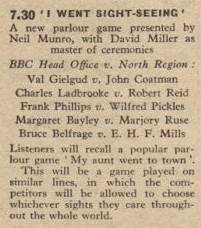
Occasionally he appeared in front of the microphone. Whilst Programme Executive at Bristol, the Western Daily Press reported that “Mr Mills, it may be said, announces fairly frequently from Bristol, and does it very well”. Whilst in post at Manchester, he even appeared in a half-hour light entertainment programme broadcast on Forces Radio in 1944. Called I went sight-seeing it took the form of a variant of the memory game My aunt went to town in which the competitors could choose any sights anywhere in the world. The contest was between a team representing BBC Head Office and the North Region. Apart from EHF Mills, the competitors were actors, radio presenters or radio announcers. The North Region team included Wilfred Pickles, who presented the popular BBC radio programme Have a go, which ran from 1946 to 1967, and which also featured his wife, Mabel.
Mills died in 1978 and is buried at Hildenborough, near Tonbridge, Kent.
This post was edited on 4 November 2022 to indicate the date and burial place of EHF Mills.
 Brimington and Tapton Local History Group