In this post we take a look at an 1890s ‘baby farming’ incident in Brimington. From Andy Miles (and our thanks to him for sharing it with us), it takes a look at an incident reported in contemporary newspapers. The article, slightly edited here and with additional illustrations, was originally published in the Hasland Magazine.
The story not only reveals details about the sad case, but also some the comings and goings of the justice system of the time. Including a charge of manslaughter, that was almost immediately struck-down, once it made its way from Chesterfield to the Autumn Assizes at Shire Hall in Derby.
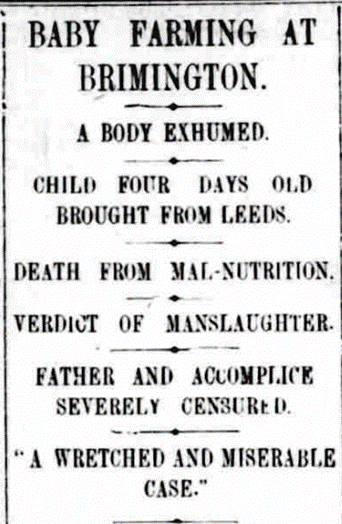
The Pearsons of Whittington Road and two babies
There was a two up, two down dwelling at Toplis Cottage on Whittington Road (the modern Station Road), Brimington. In 1898 nine people were living in that cottage. They were, Mr and Mrs Pearson, Mr Pearson’s mother and father, her brother and sister-in-law, her 14-year-old brother, and two babies.
When Deputy Chief Constable Carline visited the house on 20th October 1898 and saw Mrs Pearson, on going upstairs he found two children asleep in bed. Mrs Pearson said that one was Harold Hughes and she and her husband had received him on 9th August 1898 with £10 and an ‘agreement.’ She said the other child was illegitimate and was received from a Mrs Coulson at Sheffield railway station on November 5th, together with £40, and a ‘memorandum’. The child’s name was Mildred Grey Wood.
Mr Carline had gone to Mrs Pearson’s house because of the death of another baby. This child, Wilfred Hill Miller was the child of servant Lily Miller, 18 and Joseph Hudson, her employer. Lily Miller had told Mr Hudson and her mother that she was ‘enceinte’ – the word used by Victorians for pregnancy. Mrs Miller had made arrangements with a friend from Hull who lived in Leeds for her daughter to give birth at her house. This lady, Mrs Dixon, had had ten children, of whom seven had lived to adulthood and so she had some experience of childbirth. At the same time Mr Hudson had confided in a female friend, Mrs Isabella Tadman, of his predicament and Mrs Tadman had agreed to help him.
Mrs Tadman scoured the newspapers for certain advertisements and found an entry in the Yorkshire Post which said ‘A respectable couple wish to adopt a child, premium £ 20. Address Mrs Ward, Toplis Cottages, Whittington Road, Brimington, near Chesterfield.’ This advert had been placed in her maiden name by Mrs Pearson.
Mrs Tadman and Mrs Pearson exchanged various letters and had come to an arrangement that Mrs Pearson would take the child from Mrs Tadman outside the first class waiting room of Leeds railway station.
A baby is born in Leeds
Lily Miller gave birth to the little boy on Saturday 24 September 1898. Mrs Tadman went to Mrs Dixon’s house on Wednesday 28th September and asked for the child, but it had no clothes so Mrs Tadman gave Mrs Dixon ten shillings and asked her to buy some. She went out and purchased two white shawls in which the baby was wrapped. She took it to Leeds railway station and the baby and twenty pounds in gold coins were given to Mrs Pearson and she took the train back to Chesterfield.
However, Mrs Pearson did not have the means to feed the child and she had made arrangements with 41-year-old Mrs Townsend of Holywell Street, Chesterfield. Mrs Townsend was the wife of Herbert, a blind basket maker.
At the inquest into the baby’s death Mrs Townsend said that a stranger,
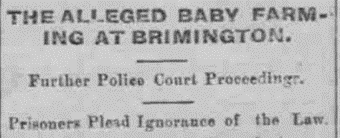
Mrs Pearson had called at her house and asked her if she could recommend anyone as a nurse. Mrs Townsend told her she didn’t do nursing anymore, but Mrs Pearson said it was for a baby, the child was her sister’s and was only a few weeks old. Mrs Townsend said she would take the child for a week for six shillings. Mrs Pearson said she was fetching the child from Leeds, and she came back with the child at nine o’clock that evening. She then told her it was only four days old. Mrs Pearson called again on Thursday 29th September and brought some clothes for the baby.
Mrs Pearson came again on Saturday 1st October and asked Mrs Townsend if she would adopt the child for £ 5. Mrs Townsend declined. Mrs Pearson told her that two Doctors were attending her sister, and she would wait to see if she got any better.
Mrs Townsend had initially fed the child upon cow’s milk and water from a bottle, and afterwards upon Nestles’ condensed milk and water. The child was frequently sick and was also suffering from thrush.
On Sunday 9th October Mrs Towndrow felt that the baby was ill and took him to see Mr J H Booth, a surgeon, in Chesterfield. He saw him and said that he was very ill. She took him again the next day, 10th October and Mr Booth told her to feed the baby by spoon only.
The baby died at 01:45 Wednesday morning 12th October. On Monday 10th October Mrs Towndrow had sent for Mrs Pearson, and she accompanied Mrs Townsend to see Mr Booth. Mrs Pearson had again said that it was her sister’s child. Mr Booth told Mrs Pearson that she would very likely be in trouble if the baby died.
Death of a baby
After the child died on 12th October Mrs Townsend sent for Mrs Pearson. At 09:30 Mrs Townsend went alone to Mr Booth’s and asked him for a certificate of the baby’s death. He gave a certificate indicating that death was due primarily to deficient nutrition and secondly to thrush. Mrs Townsend told him that she thought the baby’s name was Wilfred Hall. Between 10:00 and 11:00 on the same day Mrs Pearson came down and went with Mrs Townsend to see the Registrar, Mr W C Furness at his office in Saltergate.
He was shown the death certificate and the birth certificate that Mrs Pearson had. Mr Furness noticed a difference on each certificate – the birth certificate showing Wilfred Hill Miller, the death certificate Wilfred Hall. Mrs Pearson was unable to explain the difference in the names and as a consequence
Mr Furness refused to grant an order for burial.
Spital cemetery burial
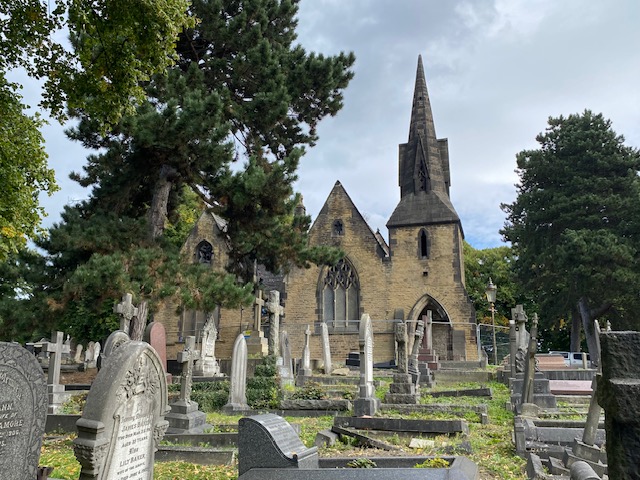
On Friday October 14th Mrs Townsend had been to the cemetery to see about the burial and she told the curator at Spital Cemetery, Mr Surguy, that Mrs Pearson had given the deceased a false name, and that there was a ‘bother’ about it. Mr Surguy said that the baby could not be buried until Monday 18th October, and he saw Mrs Pearson the same day and she gave him £ 1 13s 6d for funeral expenses.
Mrs Townsend saw Mr Furniss and asked if he had the birth certificate. He had not, but he said that the body must be buried that day, and he would afterwards let Mr Surguy know when things were settled.
At four o’clock that afternoon Mrs Townsend took the coffin containing the child’s body to the cemetery. The Reverand Mr Pyper performed the burial service. At that time the death had not been registered and there was no order for burial, but Mrs Townsend did not know what to do for the best.
Mr Surguy told the inquest that he had buried the coffin in the third-class ground, grave number 6499. On the coffin had been the name Wilfred Hill Miller. He had, today, disinterred the coffin and the coffin viewed by the jury today was the one that he had buried on Monday last, containing the deceased’s body.
Guilty of Manslaughter?
At the end of their deliberations the inquest jury decided that Mrs Pearson was guilty of Manslaughter.
It was therefore necessary for the case to be heard before the Assizes in Derby and they were heard on Tuesday 29th November 1898. And let us remember that the Autumn Assizes at Shire Hall Derby was a grand affair.
Presiding was Mr Justice Matthew. His Lordship was accompanied by Sir George Reresby Sitwell (High Sherrif of the county), Mr B Scott Currey (Under Sheriff), Rev J Howell (Sheriff’s chaplain), and Mr W B Delacombe (Sheriff’s officer.) The Grand Jury was sworn in and were Sir John Alleyne, Bart. (foreman). Sir A P Heywood, Bart. Colonel Cavendish, Mr A F Hurt, Mr W H G Bagshaw, Mr H W Walthall, Mr Fitzherbert Wright, Mr H C Chandos Pole-Gell, Mr G F Meynell, Mr G W Peach, Mr F C Arkwright, Mr W C Haslam, Mr E S Mills, Mr W L Cope, Mr F O Fitzherbert Bateman, Mr H Swingler, Mr V H Mellor, Mr James Oates, Mr John Borough, Mr J G Crompton, Mr George T Whitehead, Mr W G Copestake. So, not quite a jury of one’s peers! More like a jury of local dignitaries.
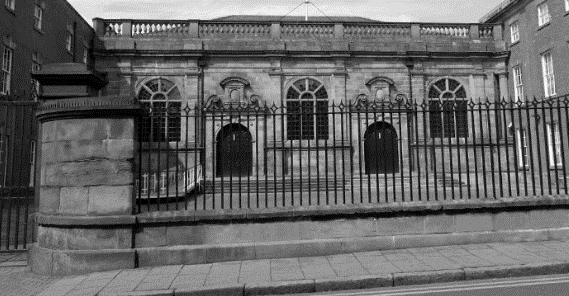
Various cases were heard on the day, and the case against Mr and Mrs Pearson. Mrs Pearson was taken before the Grand Jury but was not placed in the dock before the Court rose for the day. His Lordship enquired what counsel for the prosecution had to say in regard to this case.
Mr Etherington Smith said that Mr Garratt was only instructed that morning for the prosecution, and he was not in Court at that time. His Lordship asked if Mrs Pearson had been in custody or on bail. When he found that she has been in custody his Lordship said he could not understand why, the Magistrates had refused to commit her, why, therefore had the woman been kept in gaol upon the coroner’s inquisition? He again asked why counsel was not present and was informed that counsel was still in London but was on his way.
His Lordship then said ‘It seems to me that there is not the slightest evidence against her, and I, therefore, order her to be discharged at once!’ And so the judgement of the inquest jury that this was Manslaughter was struck down by the judge without any hearing of the evidence!
Another charge
The other charge that was made by the Magistrate’s Court regarding the two children they already had was that they had not registered them under the Infant Life Protection Act 1897. For failing to register the children they were find £5 each or 28 days for Mrs Pearson and a calendar month for her husband Benjamin Pearson.
In the 1911 Census Mr and Mrs Pearson were living in Bulwell, Nottinghamshire, and living with them were their two adopted children Harold Hughes and Mildred Annie Gray,
As for Mrs Townsend, in the 1911 census she declared that she had had nine children of whom three were living and seven had died. Perhaps she had included little Wilfred Hill Miller.
And the ‘Ogress of Reading’
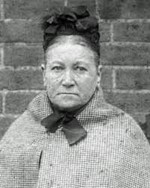
The interest in this case may well have been caused by the case of the so-called ‘Ogress of Reading’.
Just before the revelations of this baby farm case in Brimington a woman, Amelia Hobley, was hanged in June 1896 for killing a baby, Doris Marmon.
However, the police believed that in fact, the ‘Ogress of Reading’, had murdered and disposed of between 200 and 400 babies. A poem of the time ran: –
The old baby farmer, the wretched Miss Dyer
At the Old Bailey her wages is paid.
In times long ago, we’d ‘a’ made a big fire
And roasted so nicely that wicked old jade.
 Brimington and Tapton Local History Group
interesting
LikeLike
This is very sad. I vaguely remember reading something about a baby farm. These poor babies & mothers who have them up. I think they believed they would have a better life? I’m not sure if I’m remembering correctly.
LikeLike